Know what's under your bore
before you drill it.
Draw a line on the map. BoreCast shows you the soil beneath it — clay, sand, gravel, rock, all the way to 25 feet — built from real well logs your neighbors already drilled.
How it works.
You draw a line on a map, and we read the soil underneath it from real driller-reported well logs. That's it.
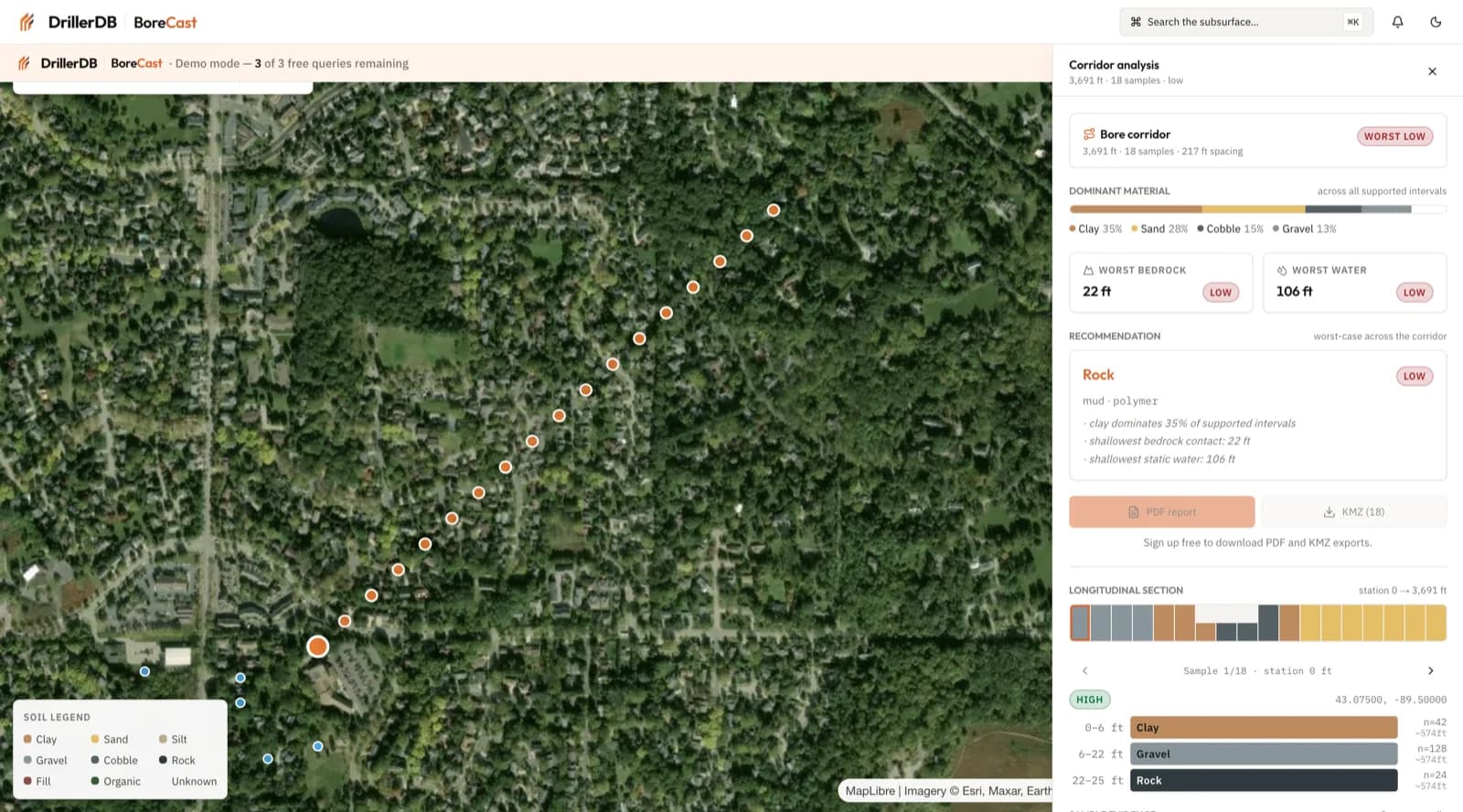
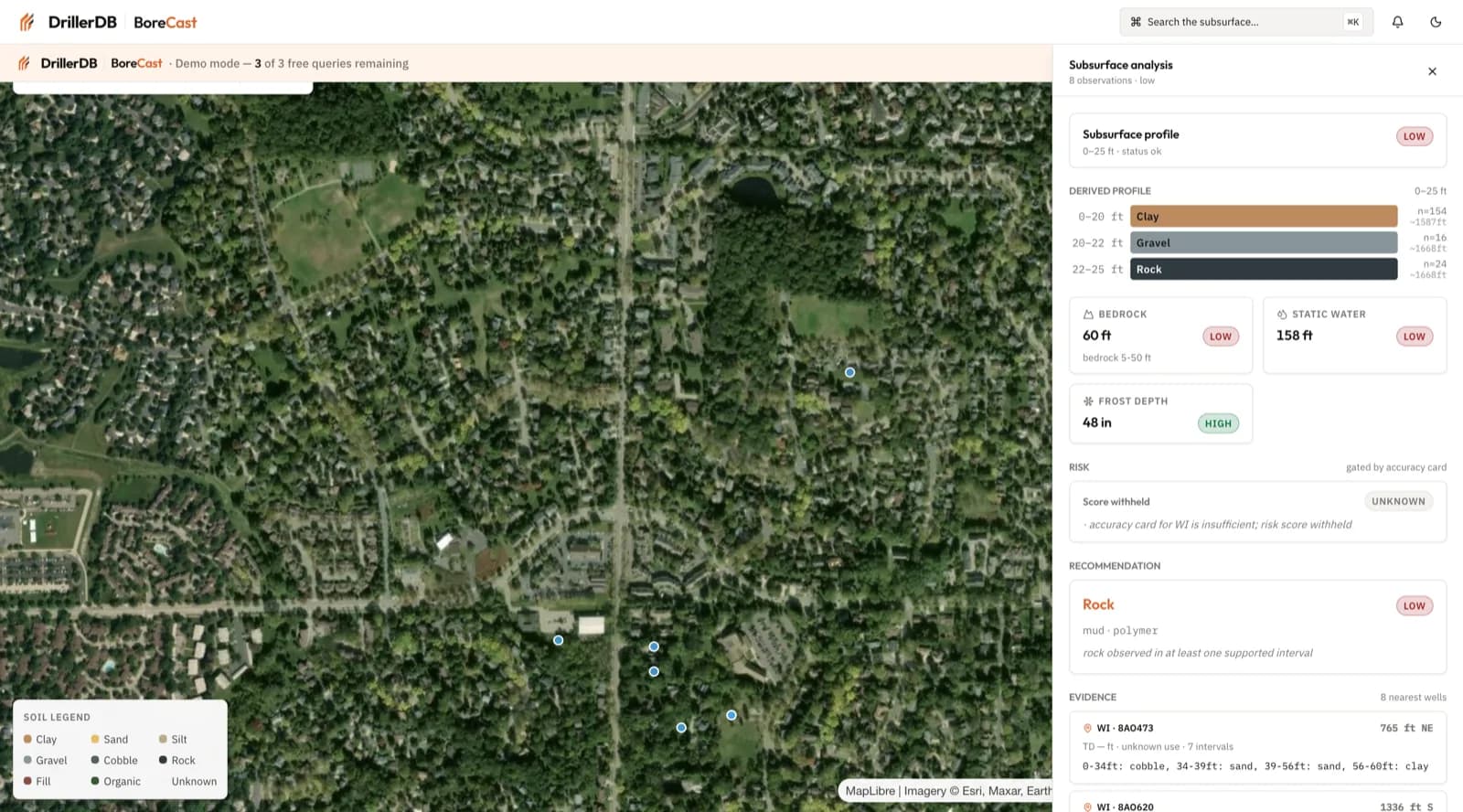
Draw your bore, see your soil
Click a point or draw a corridor line on the map. BoreCast walks every real well log nearby and shows you clay, sand, gravel, or rock at each depth. No guessing, no generic soil maps.
Honest when we don't know
If the nearest well log runs out of data at 12 feet, BoreCast says so. We never fill in gaps with made-up confidence. You see exactly where the evidence ends.
Export to KMZ, PDF, or print
Drop the bore into Google Earth. Hand a branded PDF to your project manager. Every export carries the source well IDs so your crew can trace any answer back to the driller who logged it.
We're not strangers to a drilling rig.
BoreCast is built on top of DrillerDB, the well-drilling management platform that has been digitizing state well log data since 2014. The same data drillers have used to run their businesses now powers HDD bore planning, classified for the decisions that matter at 4–25 ft.
BoreCast's founder grew up in the family well-drilling business in Wisconsin. The 4–25 ft window matters because we've stood next to the rig watching it bind on cobble.
DrillerDB has been digitizing state well logs for ten years. BoreCast queries them live — same data, classified for HDD instead of well drilling.
Wisconsin, Michigan, Minnesota, Texas, Missouri and 17 others have dense well-log coverage today. Shangguan global ML fills the rest of CONUS.
Simple pricing. No per-query surprises.
Free forever for three corridors. Pro unlocks unlimited corridors and exports. Enterprise is hand-sold when you need SSO or a custom contract.
Three corridors per calendar month, included.
- 3 corridor queries per calendar month
- Watermarked PDF only
- Point + corridor analysis
- Honest unknown gaps with explicit confidence bands
For HDD contractors planning real jobs.
- Unlimited corridors
- Full PDF + KMZ exports
- Query history
- Email support
- Passkey + Google sign-in
Fleet deployments, SSO, and white-label.
- Custom contract + SLA
- SSO (SAML / OIDC)
- Account manager
- White-label option
- Priority data expansion
Frequently asked
- Is BoreCast a substitute for calling 811?
- No. BoreCast is a planning tool, not a utility locator. Always call 811 before you excavate.
- Where does the data come from?
- Real driller-reported well logs from state well datasets — over a million wells today, across 22 states. When a driller reports clay from 0-7 feet and sand from 7-25 feet, that's what you see in BoreCast. No interpolated soil maps, no fabricated confidence.
- What if there's no well log near my bore?
- Then BoreCast tells you so. We mark the profile as 'unknown' with explicit gaps, and lower the confidence so you know to gather more data before drilling. We never fill in blanks with made-up numbers.
- Can I export to Google Earth?
- Yes — Pro accounts export every corridor as a KMZ for Google Earth and as a branded PDF report for your project manager. The Free tier gets a watermarked PDF; KMZ unlocks on upgrade.
- Do you store my bore paths?
- Your corridor history is private to your account and used only so you can re-open past queries. We never share bore paths with third parties, and we never expose the personal information of the drillers behind the well logs.
- What states do you cover?
- Wisconsin has the deepest coverage today (almost 900,000 wells). Michigan, Minnesota, Texas, Missouri and 17 other states have solid coverage, with more being added every month. Outside those states BoreCast falls back to a global bedrock model so every query still returns something useful.